Manufacturing equipment produces a constant stream of information. Machine states, cycle counts, temperatures, production rates, equipment failures and operator observations can all reveal how production is performing. The challenge is collecting that information consistently and making it useful soon enough to act on it.
The Industrial Internet of Things (IIoT) helps solve that problem by connecting machines, sensors and software so operational data can be collected, communicated and analyzed with less dependence on manual reporting. But connecting equipment is only the beginning. The real value of IIoT in manufacturing comes from turning machine data into information that helps teams identify losses, respond to problems and make better production decisions.
What Is the Industrial Internet of Things (IIoT)?
The Industrial Internet of Things (IIoT) is the use of connected sensors, devices, machines and software to collect, exchange and analyze data in industrial environments. In manufacturing, IIoT connects activity on the plant floor with systems that monitor, store, analyze or visualize production information.
Instead of relying entirely on manual checks, isolated machine displays or end-of-shift reporting, manufacturers can gain a more continuous view of equipment condition and production performance. IIoT is closely associated with smart manufacturing and Industry 4.0, but its practical purpose can be straightforward: capture useful information from manufacturing processes and make it available to the people and systems that can act on it.
Common IIoT data points include machine running and stopped states, cycle counts, production output, downtime events, temperature, vibration, pressure, equipment condition, cycle time, energy use and quality-related process conditions.
The important question is not simply, “What can we measure?” It is, “What information will help us make a better operational decision?”
How Does IIoT Work in Manufacturing?
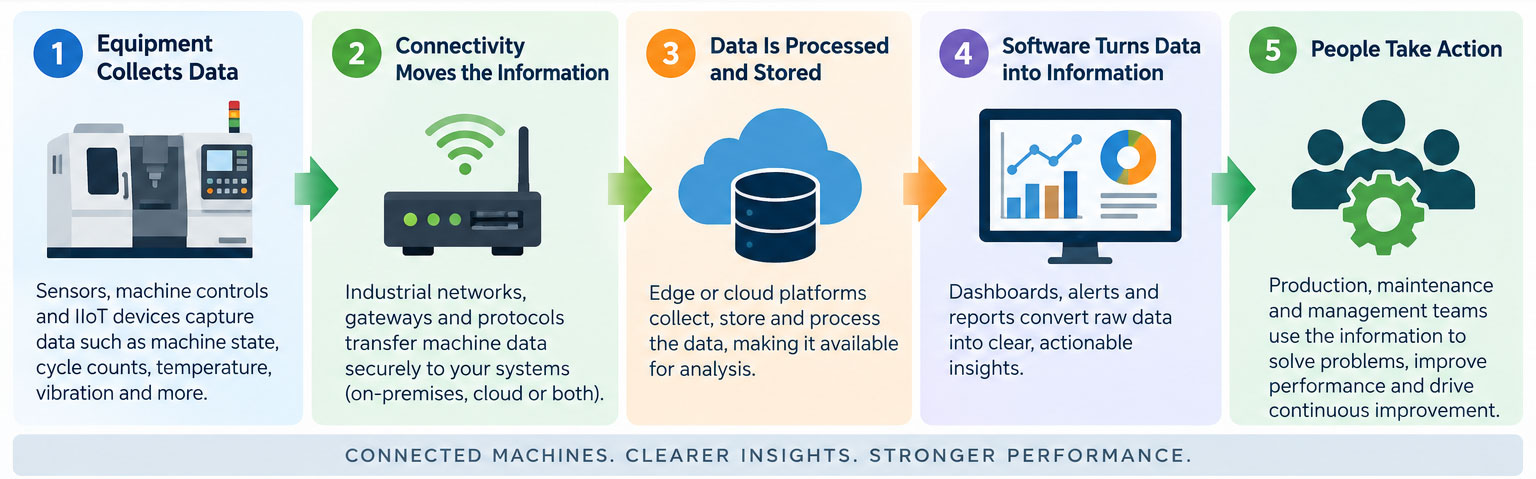
Most manufacturing IIoT systems follow the same basic path: physical equipment generates data, connectivity moves it, software processes it, and people or systems use the resulting information to take action.
- Equipment and sensors collect data. Information may come from machine controls, PLCs or sensors added to equipment to measure operating states and conditions.
- Connectivity moves the information. Industrial networks and gateways transfer selected machine data to systems where it can be processed, stored or analyzed.
- Edge or cloud systems process the data. Information may be processed close to the machine, in the cloud, on local infrastructure or through a hybrid architecture.
- Software turns data into usable information. Dashboards, alerts, reports and analytics help production, maintenance and management teams understand what is happening.
- People or systems take action. The information can support decisions about downtime, maintenance, production, quality and continuous improvement.
Common IIoT Applications in Manufacturing
IIoT becomes most valuable when it is tied to a specific production problem rather than treated as a technology project by itself.
Real-Time Production Monitoring
Connected equipment can provide current information about machine states, output and production activity. Supervisors can identify developing problems sooner instead of waiting for manually compiled reports. For a deeper look at how production information can be collected and distributed, see Thrive’s automated production reporting page: https://www.downtimecollectionsolutions.com/automated-production-reporting/.
Machine Downtime Tracking
IIoT can automatically detect when equipment stops and provide machine information that supports more accurate downtime records. However, knowing that a machine stopped is not enough. Manufacturers still need context such as duration, reason, frequency and operational impact. Thrive’s machine and equipment downtime tracking guide explains how that data becomes structured downtime information: https://www.downtimecollectionsolutions.com/downtime-tracking/.
Condition Monitoring and Predictive Maintenance
Sensors can monitor variables such as vibration, temperature and pressure for changes that may indicate deteriorating equipment condition. When reliable data and maintenance processes are in place, this can support condition-based or predictive maintenance decisions before a problem develops into a larger failure.
Production Performance Analysis
IIoT data can help manufacturers examine cycle times, throughput, equipment utilization and other production measures across machines, lines and shifts. This creates a stronger evidence base for identifying bottlenecks and measuring improvement.
Quality and Process Monitoring
Connected sensors can track process conditions that influence product quality. When defects or process deviations occur, historical operating data can provide additional context for investigating what changed and where the problem originated.
Key Benefits of IIoT in Manufacturing
The benefits of industrial IoT in manufacturing do not come simply from connecting more equipment. They come from gaining better information and using it to improve operations.
Greater production visibility: Connected data can reduce blind spots between machines, shifts and production areas.
Faster identification of problems: Real-time information can make equipment stops and abnormal conditions visible sooner.
More consistent manufacturing data: Automated collection reduces dependence on handwritten logs, spreadsheets and operator recollection for information machines can capture directly.
Reduced downtime: Better visibility into equipment status, recurring stops and operating conditions can help teams identify sources of lost production.
Better maintenance decisions: Condition and failure data can help maintenance teams determine which assets require attention and why.
Stronger continuous improvement: Historical data provides a baseline for comparing performance before and after corrective actions.
The adoption of connected manufacturing technology is no longer limited to experimental projects. Deloitte’s 2025 Smart Manufacturing and Operations Survey of 600 executives at large manufacturers found that 46% were using IIoT solutions at the facility or network level, while 57% reported using cloud computing and 57% data analytics. The same survey reported average improvements of 10%-20% in production output and 10%-15% in unlocked capacity from smart manufacturing initiatives. Source: Deloitte, 2025 Smart Manufacturing and Operations Survey.
The Role of Cloud and Edge Computing in IIoT
Cloud software can provide a centralized environment for storing, analyzing and accessing manufacturing information without requiring every application to operate entirely on local plant infrastructure. This can make it easier to deploy specialized applications, view information from different locations and scale reporting across production areas or facilities.
Cloud computing is not the only option. Some manufacturing applications require local or edge computing because of latency, connectivity, bandwidth or operational requirements. Edge systems can process selected information close to the equipment, while cloud platforms can support broader storage, reporting and analysis.
For many manufacturers, the practical answer is a hybrid approach: process time-sensitive information locally while using cloud-based systems where centralized access, analysis and scalability add value.
Can IIoT Work With Older Manufacturing Equipment?
Yes. IIoT does not necessarily require replacing existing manufacturing equipment. This is an important distinction for plants with productive machines that were installed before modern connectivity became standard.
Depending on the equipment and the information required, manufacturers may be able to collect data through existing controllers and PLCs, industrial gateways, protocol converters or externally installed sensors. The right approach depends on what the machine already provides and what information is missing.
Before retrofitting a legacy machine, define the operational decision first. Is the goal to understand downtime, monitor equipment condition, improve production visibility or investigate quality? Connecting a machine without a defined use for its data can create more information without creating more value.
Common Challenges of Implementing IIoT
IIoT can improve manufacturing visibility, but implementation requires more than installing sensors. Several challenges repeatedly determine whether connected data becomes useful.
Integrating Different Equipment and Systems
Factories often contain equipment from different manufacturers, generations and control architectures. Creating consistent data across these systems may require gateways, protocol translation and careful integration between operational technology (OT) and information technology (IT).
Data Quality and Context
More data does not automatically mean better insight. A machine-state signal may show that equipment stopped, for example, but it may not explain whether the cause was a mechanical failure, changeover, material shortage, quality issue or operator intervention. Useful analysis depends on adding the right operational context.
Cybersecurity
Connecting industrial systems creates additional security considerations. Network architecture, access controls, device management and data security should be part of the implementation plan from the beginning rather than added after systems are connected.
Connectivity and Reliability
Manufacturing environments need dependable systems. Teams should consider what happens when network connectivity is interrupted, whether data must be buffered locally and which functions require local processing.
Cost and Scalability
The business case should be tied to a measurable operational problem. Attempting to connect every possible asset at once can add cost and complexity without proving value.
Workforce Adoption
Operators, maintenance teams, engineers and managers ultimately need to trust and use the information being generated. Technology that does not fit the workflow can produce large amounts of data without producing meaningful improvement.
Turning IIoT Data Into Action
Collecting manufacturing data is not the objective. The objective is to use that data to understand losses, prioritize action and measure whether changes improve performance.
A practical IIoT improvement cycle is: Collect → Contextualize → Analyze → Prioritize → Act → Measure.
For example, machine connectivity may reveal repeated short production stops. Downtime tracking can classify those events and determine their duration and frequency. Analysis can then show which causes account for the greatest production loss. The team can address the highest-priority cause and use the same data to determine whether the change actually reduced downtime.
That creates an operational feedback loop rather than simply a growing database of machine information.
How IIoT Connects With OEE and Continuous Improvement
IIoT data can also support broader manufacturing performance measurement. When reliable production, downtime and quality information is available, manufacturers can use it to understand availability, performance and quality losses more consistently.
That makes IIoT a useful data foundation for Overall Equipment Effectiveness (OEE), while OEE provides a framework for interpreting how effectively planned production time is being used. Thrive’s OEE tracking resource explains availability, performance and quality in more detail: https://www.downtimecollectionsolutions.com/overall-equipment-effectiveness/.
The distinction matters: IIoT connects and captures data; OEE and other improvement methods help manufacturers interpret performance and decide where improvement efforts should focus.
Getting Started With IIoT Without Overcomplicating It
Manufacturers do not need to connect an entire facility at once. A focused implementation can be easier to validate, easier for teams to adopt and easier to scale.
- Start with a defined problem. Identify a measurable production, downtime, maintenance or quality issue.
- Determine the data required. Decide which machine states, conditions or events are needed to understand that problem.
- Use existing data where possible. Review PLCs, controls and existing sensors before adding new instrumentation.
- Connect only what supports the objective. Avoid collecting data simply because it is available.
- Give the data operational context. Define reason codes, thresholds, production standards or other information needed to interpret the signals.
- Make the information visible to the right people. Dashboards and reports should support decisions, not just display metrics.
- Measure the result before scaling. Prove that the use case produces useful insight or measurable improvement, then expand.
A focused example might be excessive unexplained downtime on a critical line. The required data could include machine state, stop duration and downtime reason. The objective would be to identify recurring causes and reduce lost production time. Once that process works reliably, the same approach can be extended to additional machines or lines.
How IIoT and Downtime Tracking Work Together
For manufacturers focused on production performance, IIoT and downtime tracking serve complementary roles. IIoT provides connectivity and machine data. Downtime tracking turns production interruptions into structured operational information.
Together, they can help manufacturers determine when equipment stopped, how long production was interrupted, which assets were affected, why downtime occurred, which causes recur most frequently and whether corrective actions improved performance.
Thrive helps manufacturers capture and analyze downtime and production information so teams can move from knowing that equipment stopped to understanding where production time is being lost and what deserves attention. The goal is not more data for its own sake; it is better visibility and better decisions.
Frequently Asked Questions About IIoT in Manufacturing
What does IIoT stand for?
IIoT stands for Industrial Internet of Things. It refers to connected sensors, machines, devices and software used to collect and exchange information in industrial environments.
What is the difference between IoT and IIoT?
IoT is the broader concept of connected devices exchanging data. IIoT applies connected technologies to industrial environments such as manufacturing plants, where equipment performance, reliability, production and operational conditions are central concerns.
Does IIoT require replacing existing manufacturing equipment?
No. Existing machines may be connected through controllers, gateways, protocol converters or additional sensors, depending on the equipment and the data required.
How can IIoT reduce manufacturing downtime?
IIoT can make machine states and operating conditions visible sooner and provide data for detecting and analyzing production interruptions. That information can support downtime analysis, maintenance and corrective action.
Is cloud software required for IIoT?
No. IIoT systems can use cloud, edge, on-premises or hybrid architectures depending on operational and technical requirements.
What should manufacturers track with IIoT?
Track the data that supports a defined operational decision. Common examples include machine status, cycle counts, downtime, output, temperature, vibration, pressure, energy consumption and process conditions.
From Connected Machines to Better Manufacturing Decisions
IIoT gives manufacturers the ability to collect operational information at a scale and speed that manual processes often cannot match. But connectivity alone does not improve production.
The real opportunity is to connect the right equipment, capture the right information and use that information to make better decisions. For manufacturers trying to reduce downtime, improve visibility and understand where production capacity is being lost, IIoT can provide the data foundation. Structured downtime tracking and production analysis can then turn that data into information teams can use to improve performance.